
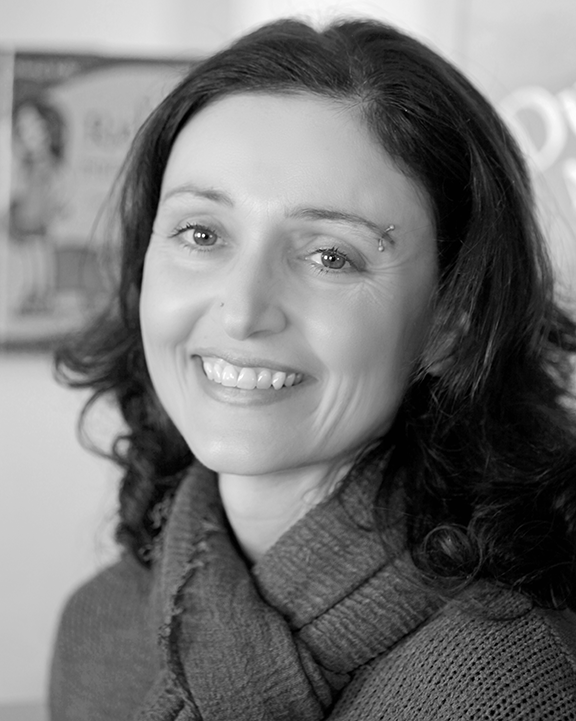
Welcome to Meet the Author! Today we’re featuring Deborah Kelly. Deborah is a multi-award-winning, internationally published author of picture books, junior fiction, middle-grade and young adult titles. Deborah is passionate about literacy and enjoys visiting schools, libraries and festival events to share her books with children. As well as being a children's author, Deb is a pediatric speech pathologist and a Role Model for Books in Homes.
You have been busy writing and have had two new releases this year with Rhiza Press—The Mighty Pipsqueak and Bring It Back. Where did the inspiration for them come from?
The Mighty Pipsqueak is the first book in the Poppy and Pipsqueak junior fiction series. Poppy lives on a farm where one of the dogs has just birthed
a litter of puppies. One is smaller than the others—a runt—and Dad says it won’t survive more than a few hours without intervention. Poppy convinces Dad to let her raise the pup and is determined to prove that small can still be mighty. After all, she was born prematurely and while she wears glasses and a hearing aid, can do everything her friends can.
This book explores themes of difference and diversity, the power of small and believing in yourself. It was inspired by the hearing lectures I attended at university during my recent speech pathology degree. I wanted kids with hearing differences to see themselves represented in books, but I didn’t want it to be the main focus. The book is also inspired by my rural childhood in New Zealand. Some of the animals that my partner and I have raised and loved feature in the series too. This book has just been shortlisted for Speech Pathology Australia’s Book of the Year Awards.
My other new release is a middle-grade novella—the first book in the Wombat Shorts series. Bring It Back is set in the final year of primary school; it’s about basketball, friendship, choices—making mistakes and making amends and deciding how far we are willing to go to ‘fit in’ or ‘be liked’. I remember this time of life well and of being in situations where I had to decide what was ‘me’ and what wasn’t.
What types of books do you write?
I write for children of all ages—from picture books through to educational readers, short stories, junior fiction series, middle-grade novels and young adult novels. I write full-length middle-grade and young adult.
I also write for the Rhiza Shorts and Wombat Shorts lists. These are short, accessible novellas for busy tweens and teens that have minimal words but maximum impact. Writing for these lists has improved my writing because you have fewer words to work with and the story absolutely needs to be fast-moving and continuously engaging. I especially love writing for these lists as accessible books like this can make reading more appealing to kids who find reading difficult, who struggle to keep their attention focused, or even just have busy lives and want a short but satisfying read. In my work as a paediatric speech pathologist, I see a significant and increasing need for accessible books like these.
What’s your writing routine?
I don’t know if I would call it a routine—life can be very busy—but I do try to prioritise writing when and wherever I can because I truly love it. I have found that good writing flows whenever I make the space and time to spend with it. So even if that is five or ten minutes, it all counts. When my kids were little, sometimes I jotted ideas down on the back of a napkin in a café or on my arm in the car (pulled over, of course!) when an idea struck. I often wrote in my head while doing dishes or changing nappies as I didn’t get a lot of sit-down writing time.
Now my kids are teenagers but having recently completed a university degree and become a speech pathologist, life is busy for different reasons. But I can daydream about my characters and their worlds at any time, including when I am driving to work.
What were some of your favourite books growing up?
I loved so many books. We read a lot of European books because my family have European roots, so The Magic Porridge Pot was a favourite. I also loved The Hungry Thing because of the nonsense words; even then, I loved to play around with language. Because we grew up in New Zealand, we read a lot of Kiwi authors, like Margaret Mahy (The Lion in the Meadow), Jow Cowley (Mrs Wishy Washy), Patricia Grace (The Kui and the Spider) and Lynley Dodd (Hairy Maclary). I loved Māori author James Waewera’s Pukunui and Moata Moa stories. Chapter book favourites included Roald Dahl for his daring and offbeat humour and Judy Blume stories that helped me navigate my tweens and teens. Maurice Gee’s The World Around the Corner, a tale of magic set in suburban Auckland, was probably my favourite chapter book as a child.
How important is it to read books when you want to be an author?
It is absolutely essential. I don’t think you can be a writer if you are not a reader. Why would you want to create books for others if you didn’t enjoy reading them yourself?
Reading allows you to absorb what works by osmosis. To discern what you like and don’t like, what is memorable, and which characters stick with you and why. And of course, it helps you to understand the all-important narrative arc—the scaffolding over which the entire book hangs. My advice to writers is to understand the points of a narrative arc and then try to identify these moments in your favourite books. It will help you understand and learn to include the essential components of a story.
What would you like to tell the budding authors who lose motivation if a few of their works don't do well?
Everything you write is an exercise in refining your craft. There are many stories I have laboured over that won’t ever be published because while elements of them worked beautifully, something was missing. The trick is to identify what isn’t there (by reading widely, doing courses, asking for feedback or being lucky enough to get feedback from a publisher who is considering your work) and work on that so that the next story is even better.
Eventually, you will have your stories considered seriously. Publishers may ask if you are willing to change/work on elements. Working with a good editor will accelerate your learning and ultimately make you a better writer. To write, you need to be sensitive but if you want to be published, you must develop a thick skin. Feedback is gold—accept it graciously and consider it carefully. I am still learning, refining my craft and considering all feedback. I don’t think that will ever stop because I always want to be a better writer.
Share three things that people may not already know about you.
I just completed a degree in speech pathology—and won the College Medal!
I have lived in four countries and travelled to around 30. My favourite places so far have been Iceland and Romania.
I love animals. Between us, my partner and I have dogs, cats, a snake, a ferret, a goat and ducks … and soon more ducklings … but I really want her to buy me a peacock!
You can follow Deborah via her website or on Facebook:
http://www.deborahkelly.com.au
https://www.facebook.com/DeborahKellyChildrensAuthor/